It was another short week under the golden dome. After floor debate and committee meetings, many legislators headed back to their districts on Wednesday afternoon.
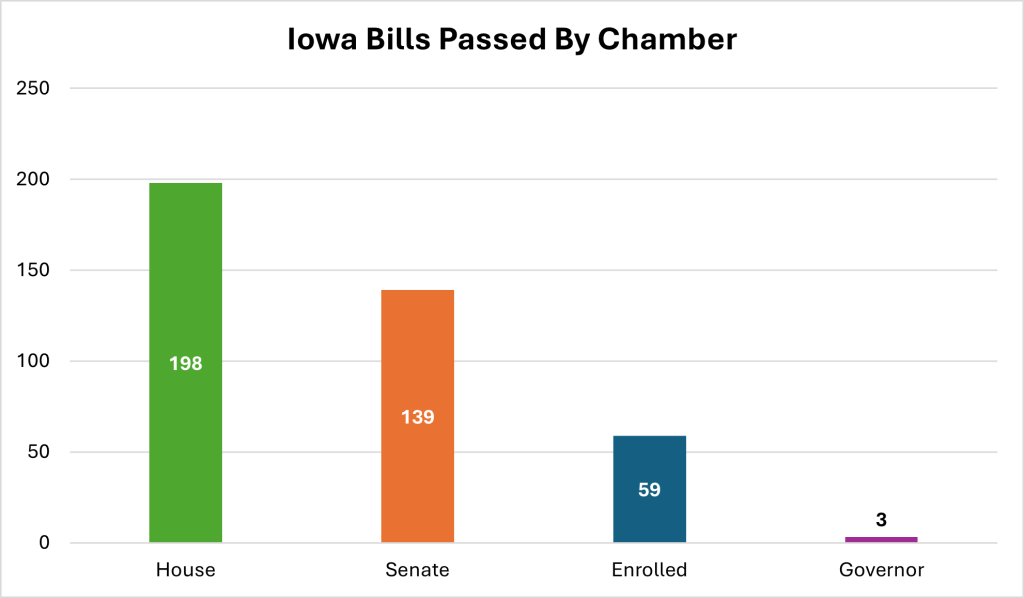
The chambers took up relatively short debate calendars on mainly non-controversial legislation, and the Senate began to hold subcommittees on the Governor’s budget bills. The House started retirement speeches for the legislators retiring from public office, signaling the beginning of the end of the 2026 legislative session.
2026 Budget Update
Before adjournment, the legislature must approve the state budget for the upcoming fiscal year. After the March Revenue Estimating Conference (REC), Governor Kim Reynolds introduced several budget bills adjusted to reflect the 9.3% decrease in state revenue. The budget process in Iowa is split into several different budget bills that are sorted by topic area. Last week, the Senate began holding subcommittees to discuss the Governor’s budgets that have been released. The legislature is not required to adopt the Governor’s budget bills; rather, they will likely develop their own budget language based on internal budget targets (the estimated amount each majority caucus plans to spend) and their priorities.
Senate Republicans Release Budget Targets
Senate Republicans released their FY27 budget target of $9.623 billion, reflecting a 1.2% increase over FY26 and coming in $47.8 million below the Governor’s proposal. Senate leadership emphasized that the budget framework continues to highlight conservative spending alongside the state’s 3.8% flat income tax, with projections showing approximately $4.8 billion in combined reserves (ending balance, Taxpayer Relief Fund, and rainy-day funds) by the end of FY27. Senate leadership signaled that negotiations with the House and Governor will continue in the coming weeks to finalize a budget aligned with priorities such as education, public safety, and taxpayer relief.
House Republicans have yet to release their budget targets, but they are expected this week. Both chambers are expected to release their draft budgets in the coming weeks and begin negotiations toward a final state budget for the fiscal year.
2026 Election Tracker
The week before last, objections to nomination petitions for state and federal offices were heard by a panel consisting of the Secretary of State, Attorney General, and Auditor of State. Individuals were removed from the June 2 primary ballot if their petitions did not hold up to the objections. Notably, after Governor candidate, Rep. Eddie Andrews, survived the challenge to his petitions, the Adam Steen campaign announced that two senior staffers who were involved in assisting the challenge would be leaving the campaign.
The tables below reflect the finalized list of candidates appearing on the ballot in the June 2026 primary. Races where there are no Democratic or Republican candidates listed can be filled by their parties after the primary.
2026 Retirements
State legislators retiring from office address the chambers in retirement speeches as session moves to a close. In the House, several legislators have spoken on their time in public office, signaling movement toward the end of the 2026 legislative session.
| Office | Name |
| U.S. Senate | Joni Ernst (R) |
| Governor | Kim Reynolds (R) |
| House District 1 | J.D. Scholten (D) |
| House District 3 | Thomas Jeneary (R) |
| House District 5 | Zach Dieken (R) |
| House District 15 | Matt Windschitl (R) |
| House District 32 | Jennifer Konfrst (D) |
| House District 33 | Ruth Ann Gaines (D) |
| House District 38 | Jon Dunwell (R) |
| House District 39 | Rick Olson (R) |
| House District 55 | Shannon Latham (R) |
| House District 75 | Bob Kressig (D) |
| House District 98 | Monica Kurth (D) |
| Senate District 9 | Tom Shipley (R) |
| Senate District 11 | Julian Garrett (R) |
| Senate District 19 | Ken Rozenboom (R) |
| Senate District 23 | Jack Whitver (R) |
| Senate District 31 | William Dotzler (D) |
What’s next?
With about two weeks until the scheduled 100th day of session, legislative leaders will focus on resolving remaining issues, including property taxes, eminent domain, and the budget. Before adjournment, both chambers must reach agreement on a final budget for the Governor to sign within 30 days of sine die.