The 2026 Legislative Session adjourned on Sunday, May 3, and in the 30 days that followed, the Governor took final action on bills. The majority of new laws took effect on July 1.
Although the General Assembly has adjourned, policymaking continues throughout the interim. Legislative study committees will continue to meet over the coming months to examine issues for potential consideration during the 2027 legislative session, while state agencies implement newly enacted laws through the administrative rulemaking process.
The October and December meetings of the Revenue Estimating Conference will establish the fiscal outlook heading into the next legislative session, and the November general election will shape the political landscape and legislative priorities for 2027.
Majority of 2026 Bills Become Effective
The Second Session of the 91st General Assembly saw the introduction of 1,373 bills and resolutions – 542 in the Senate and 831 in the House – as well as 484 study bills, including 199 Senate study bills and 285 House study bills. By the conclusion of the session, the Legislature had enrolled 206 measures for consideration by the Governor, consisting of 205 bills and one joint resolution.
Under the Iowa Constitution, the Governor has three days, excluding Sundays, to sign or veto legislation received while the Legislature is in session. For bills passed and delivered during the final three days of the session, the Governor has 30 days following adjournment to act. It is common practice for legislative leaders to hold enrolled bills and deliver them at the Governor’s request, allowing for the full 30-day review period. Unless otherwise specified, bills signed into law take effect on July 1.
By June 2, the final day for gubernatorial action on legislation passed during the 2026 session, Governor Kim Reynolds had signed 200 bills into law. Notably, the Rebuild Iowa Infrastructure Fund, Health and Human Services, Education, and Standings appropriations bills were approved with line-item vetoes. The Governor also vetoed five bills in their entirety.
Here is a complete list of bills signed and vetoed by the Governor. The list also provides effective dates for each bill. There may be multiple effective dates for a bill, which means provisions within a bill have various effective dates. When there are multiple effective dates listed, please consult the bill’s specific provisions to determine effective dates.
FY 2027 State Budget
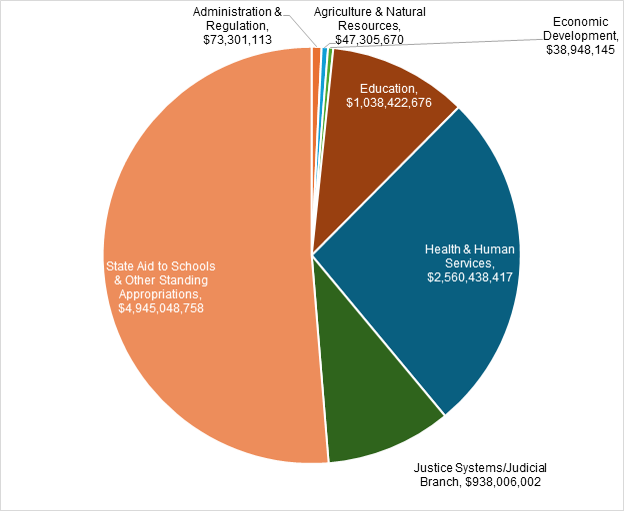
The FY 2027 budget appropriates approximately $9.6 billion from the State General Fund. The agreed-upon spending target represents a 1.2% increase over the FY 2026 budget of $9.425 billion. The budget reflects the Legislature’s continued emphasis on fiscal restraint while funding key state priorities. The General Fund appropriation breakdown is as follows:
| Administration & Regulation | $73,301,113 |
| Agriculture & Natural Resources | $47,305,670 |
| Economic Development | $38,948,145 |
| Education | $1,038,422,676 |
| Health & Human Services | $2,560,438,417 |
| Justice Systems/Judicial Branch | $938,006,002 |
| State Aid to Schools & Other Standing Appropriations | $4,945,048,758 |
| TOTAL | $9,641,470,781 |
Governor Reynolds Signs Two Executive Orders
Since the adjournment of session, Governor Reynolds signed two major executive orders outlining her interim priorities before the end of her final term.
Executive Order 19
Executive Order 19 establishes the Iowa Office of Outdoor Recreation as an extension of the Iowa Tourism Office, a division of the Iowa Economic Development Authority. The order creates a centralized structure for both public and private stakeholders to support, enhance, and expand Iowa’s outdoor recreation. The Iowa Office of Outdoor Recreation will promote the responsible stewardship of the state’s natural resources and aims to expand strategic partnerships to promote Iowa’s outdoor recreation sector.
At the press conference announcing the order, Governor Reynolds stated,
“Outdoor recreation contributes nearly $6 billion annually to Iowa’s economy and supports nearly 50,000 jobs across the state, and opportunity exists for further growth… By fostering relationships among public agencies, private businesses, and community partners, we can promote and expand what Iowa has to offer for outdoor enthusiasts, families, and visitors, elevating our state’s image as an outdoor recreation destination.”
Iowa is the 25th state to establish an outdoor recreation office. In the 120 days after the signing, a 10-person task force will advise the new office and will report its recommendations.
Executive Order 20
Executive Order 20 establishes the Iowa Medicaid Fraud Elimination Task Force to cut down on fraud, waste, and abuse within Iowa Medicaid. Iowa Attorney General Brenna Bird will serve as chair of the task force and will serve alongside the following individuals:
- Principal Deputy Director of the Department of Health and Human Services
- Director of Iowa Medicaid
- Director of the Department of Inspections, Appeals, & Licensing
- Director of Iowa’s Medicaid Fraud Control Unit
- Commissioner of the Department of Public Safety
- Director of the Department of Management
- Designated representative from the Office of the Governor
- One member from each of Iowa’s managed care organizations: Wellpoint Iowa
- Iowa Total Care and Molina Healthcare of Iowa
The task force must convene by July 17 and issue a final report with recommendations within 120 days.
Iowa SNAP Waiver Struck Down
On Monday, June 22, U.S. District Court Judge Amy Breman Jackson issued a ruling to strike down federal Supplemental Nutrition Assistance Program (SNAP) waivers in Iowa, Colorado, Nebraska, Tennessee, and West Virginia. The SNAP waivers in these states and others are part of the greater “Make America Healthy Again” (MAHA) movement championed by current U.S. Secretary of Health and Human Services Robert F. Kennedy Jr.
In Iowa, the waiver took effect on January 1 and limited the types of food SNAP participants could purchase, restricting the purchase of taxable foods such as soda, candy, and many prepared foods. However, the lawsuit filed by the National Center for Law and Economic Justice filed a lawsuit and argued that the new healthy food waivers prevented SNAP participants from meeting certain medical and allergy needs and changed the legal definition of “food” for SNAP.
The ruling supported the argument, stating that when SNAP was created, Congress did not authorize the U.S. Department of Agriculture to amend or waive the definition of food, nor to cut out certain types of food entirely from the program. As established, SNAP restrictions are limited to alcohol, tobacco, and hot foods or hot products ready for consumption. In the ruling, Judge Jackson did not argue that states could not pursue efforts to improve the health of SNAP participants, but they must do so lawfully.
In response to the ruling, Governor Reynolds issued the following statement:
“For decades, the USDA’s Supplemental Nutrition Assistance Program has fallen short of its original intent to provide low-income families with affordable access to nutritious food. With a broad definition of eligible foods – one that excludes only alcohol, tobacco, and hot foods – taxpayers are subsidizing so-called nutrition benefits that today include soft drinks and candy while 40% of American adults and 20% of children are obese,” said Governor Kim Reynolds. “I’m proud that Iowa is among the states leading the type of SNAP reforms necessary to promote better nutrition, health, and well-being. The changes proposed aren’t a mandate – SNAP members can choose what they want, but the state won’t pay for unhealthy foods. The court’s decision is short-sighted and does nothing to improve the health of our country. In the meantime, Iowa will continue to work on our plan to do exactly that.”
New Department of Health and Human Services Leadership
During the 2026 Iowa Legislative Session, former Iowa Department of Health and Human Services (HHS) Director Larry Johnson failed to secure the votes of two-thirds of senators to receive confirmation. Governor Reynolds appointed Kraig Paulsen, the Director of the Iowa Department of Management, to serve as HHS Director at the pleasure of the governor.
In the press release accompanying the announcement, Governor Reynolds wrote,
“This is not the first time I’ve called upon Director Paulsen to help lead executive branch departments during times of transition. His experience across state government is unmatched, and I have full confidence in his ability to ensure our state’s largest agency has the leadership team required, not only to serve Iowans most in need of assistance, but also to advance strategic initiatives such as rural health transformation, cancer research, and child welfare technology improvements.”
Larry Johnson will serve as Principal Deputy Director of Iowa HHS. Director Paulsen will perform all non-delegable duties and delegate the remaining responsibilities to Principal Deputy Director Johnson, pursuant to Iowa Administrative Code 441–1.3(3).
Senator Julian Garrett Passes Away
On Monday, June 8, Senator Julian Garrett (SD-11) passed away after his battle with prostate cancer. Senator Garrett was a University of Iowa Law School graduate and worked in the Iowa Attorney General’s Office as an assistant attorney general in charge of consumer protection. Garrett was a longtime member of the Warren County Republican Central Committee and the Iowa State Bar Association for over 40 years.
Senator Julian Garrett served in the Iowa Legislature for 16 years, first as a state representative before winning a special election to the Iowa Senate in 2013. In March, the senator announced his cancer diagnosis and decision not to seek re-election after his extended absence from the 2026 legislative session.
Hollie Zajicek (R) and Sinnika Waugh (D) will appear on the ballot to succeed Senator Garrett in the November general election.
2026 Primary Election
Iowa held its primary elections for the 2026 General Election on Tuesday, June 2. Of the state’s 2,147,930 registered voters, 411,663 ballots were cast, resulting in a voter turnout rate of 19.17%. Iowa conducts closed primary elections, meaning only voters registered with a political party may participate in that party’s primary and vote for its candidates.
The tables below list the candidates who appeared on the June 2 primary ballot. Candidates who advanced to the November 3 General Election are highlighted in red (Republican) or blue (Democrat). These nominees will appear on the ballot in the November General Election.
Federal Races
Statewide Races
Iowa State House of Representatives
Every two years, all 100 seats in the Iowa House of Representatives are up for election. Due to retirements and several current representatives pursuing other elected offices, 17 House districts featured open seats with no incumbent seeking re-election in 2026.
A total of 26 House districts held contested primary elections for one or both major-party nominations. Of those contests, 10 involved challenges to incumbent representatives. In districts where either the Democratic or Republican Party did not field a candidate for the June 2 primary election, the party may nominate a candidate through its party convention process to appear on the November 3, 2026, General Election ballot.
Iowa State Senate
In even-numbered years, Iowa Senate elections are held in the state’s odd-numbered districts. Of the 25 Senate seats on the ballot in 2026, nine featured open seat contests due to retirements or incumbents seeking other offices. Eight districts held contested primary elections, including three races in which incumbent senators faced primary challengers. The winners of these contests will advance to the November 3 General Election.
Bills Signed by Governor Kim Reynolds
The Governor had 30 days after sine die to sign or veto bills. Of the 206 bills and resolutions passed by both chambers, Governor Reynolds signed 200, vetoed five, and one resolution was messaged to the Secretary of State.
Bills Vetoed by Governor Kim Reynolds
Governor Kim Reynolds exercised her line-item veto authority on four appropriations bills and vetoed five bills in their entirety. Detailed explanations of each veto are provided in the Governor’s June 2 veto messages and accompanying press release.