Week six of the 2026 Iowa Legislative Session marked the first major milestone of the 2026 legislative session: the first funnel. By Friday, February 20, most bills that were introduced in either chamber must be voted out of committee in the originating chamber to remain eligible for consideration.
The “funnel” deadline does not apply to select bills, namely appropriations, ways and means, leadership bills, and bills related to administrative rules. The goal of the funnel is to narrow the focus of legislative priorities, which was necessary after 2,891 bill introductions in the first six weeks of session.
Last week featured a heavy subcommittee schedule on the front end and packed committee agendas near the end of the week. Additionally, the House amended and passed the Senate’s bill to set the supplemental state aid for school districts in the upcoming fiscal year.
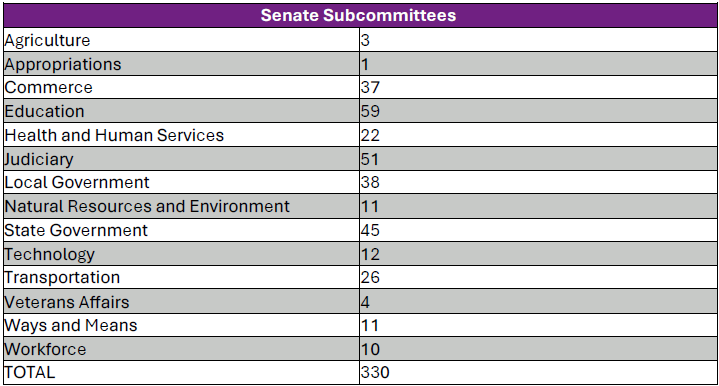
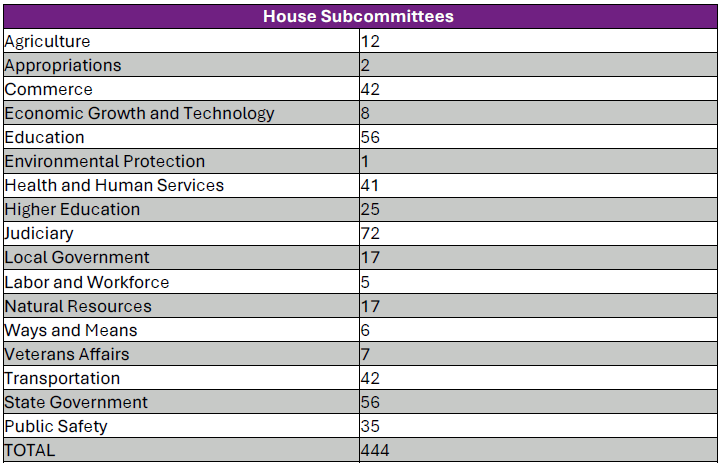
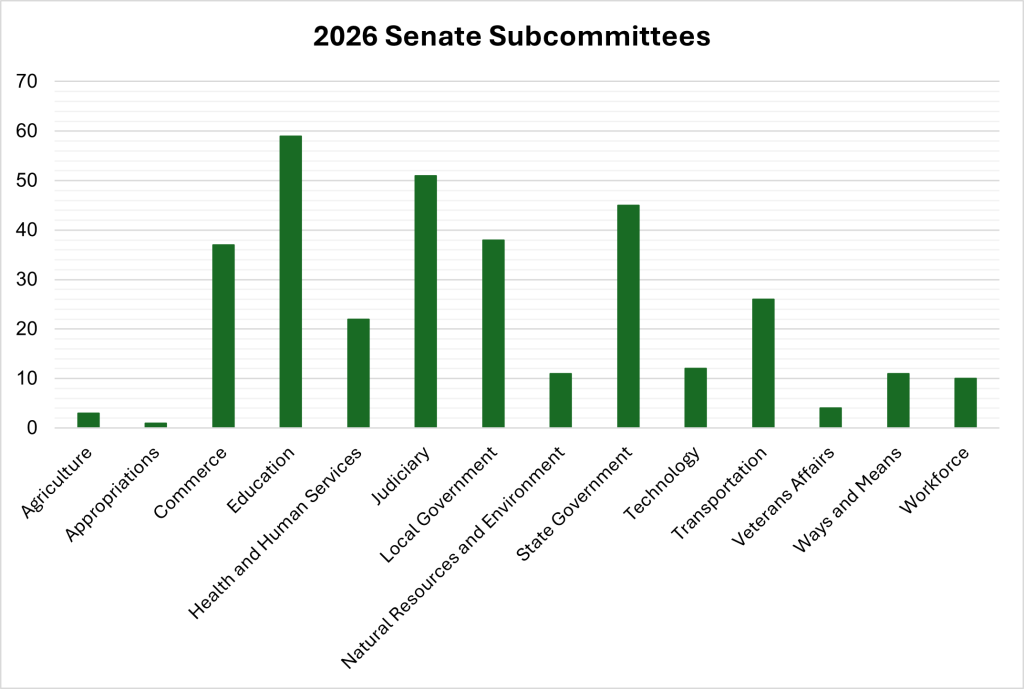
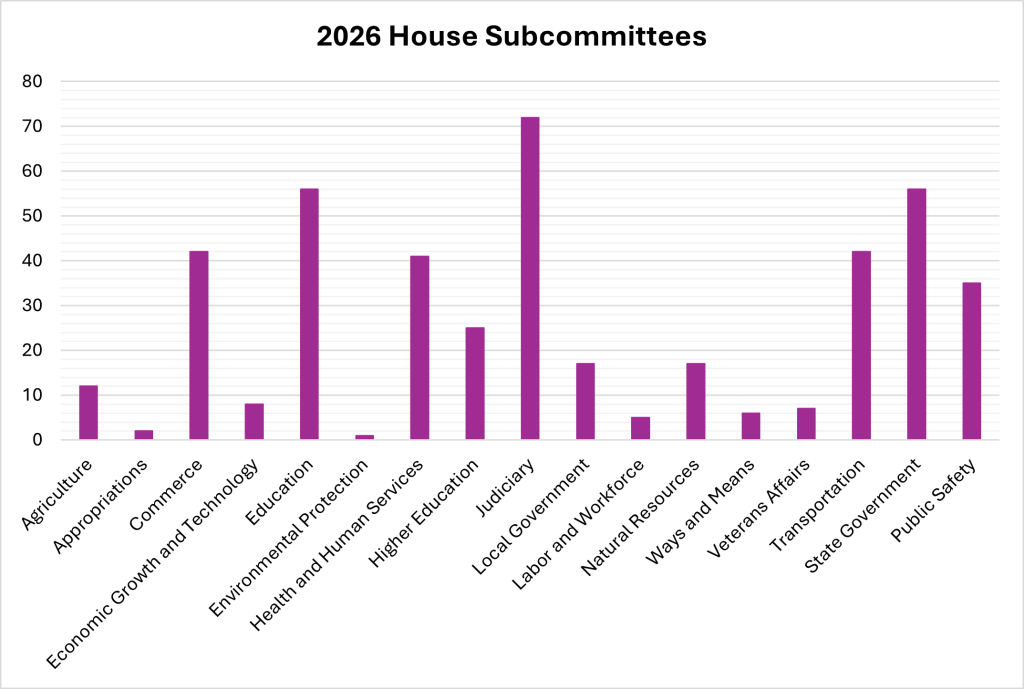
2026 Subcommittee Report
After a bill is drafted by the Legislative Services Agency (LSA), it is introduced on the chamber floor and referred to the relevant standing committee.
The committee chair then assigns the bill to a subcommittee, made up of three members: two from the majority party and one from the minority party (sometimes more members depending on the bill). A subcommittee meeting is scheduled, providing an opportunity for legislators, members of the public, and registered lobbyists to offer comments on the bill and to discuss its potential impact.
If at least two of the three subcommittee members sign the report with a recommendation to pass the bill, the bill becomes eligible for consideration by the full committee. However, the committee chair decides if and when the bill is placed on the full committee agenda.
To remain eligible for consideration after the first legislative “funnel” deadline, most policy bills must pass out of their assigned committee with a majority vote. Bills that fail to advance by the funnel deadline are generally no longer eligible for consideration during that session, subject to certain exceptions (e.g., tax and appropriations measures).
Aware of this looming deadline, legislators packed the days leading up to the week of the first funnel with subcommittee meetings. The pace was brisk.
During the first six weeks of the 91st General Assembly, lawmakers advanced a total of 774 bills out of subcommittee. Nearly half of those subcommittee meetings occurred in the final two weeks before the funnel deadline. A clear illustration of how compressed and deadline-driven the legislative process becomes this time of year.
Supplemental State Aid Passes House
Each year, the legislature addresses supplemental state aid (SSA) early in the session to provide school districts with advance notice for budget preparation and certification. SSA provides additional funding to account for annual inflationary increases.
Earlier this month, the Senate debated and passed SF 2201, which would set the SSA increase at 1.75%. That rate increase would be lower than the 2.5% and 2% increase in 2024 and 2025, respectively. The bill was sent over to the House where it advanced through subcommittee and full committee before being debated on the floor Thursday afternoon.
The House amended SF 2201 to set the SSA increase at 2%, which is .25% lower than their initial proposal, and the bill passed by a vote of 58-35. The amended version returns to the Senate for consideration. Both chambers must agree on a final percentage before the bill can be sent to the Governor for signature.
In Memory of Billie Ray
Former Iowa First Lady Billie Ray passed away last week, prompting tributes from leaders across the state. Known for her grace, warmth, and commitment to service, Billie devoted her life to strengthening Iowa communities and expanding opportunities for young people.
Alongside former Governor Robert D. Ray, she co-founded the Robert D. and Billie Ray Center at Drake University in 1997. The Center has become nationally recognized for its work promoting character education, ethical leadership, and civility impacting generations of Iowa students.
Her legacy is one of quiet but profound influence: championing education, modeling public service, and investing in the next generation of leaders. Iowa is better because of her dedication and example.
What’s next?
Now that the first funnel deadline has passed, attention will shift to floor debate as legislators work to pass bills and send them over to the opposite chamber ahead of the second funnel deadline on March 20. By this date, all non-taxation and funding bills must have passed through committee in the opposite chamber to remain eligible for consideration in 2026.
At the same time, more substantive negotiations will begin behind the scenes about appropriations and major 2026 legislative issues, with draft budget proposals expected in the coming weeks.