Week 11 of the 2026 Iowa Legislative Session was the first week after the second funnel deadline, which substantially narrowed the bills eligible for consideration. Last week, the Senate could only consider House bills, House joint resolutions, and bills placed on the unfinished business calendar; likewise, the House took up only Senate bills, Senate joint resolutions, and bills placed on the House unfinished business calendar.
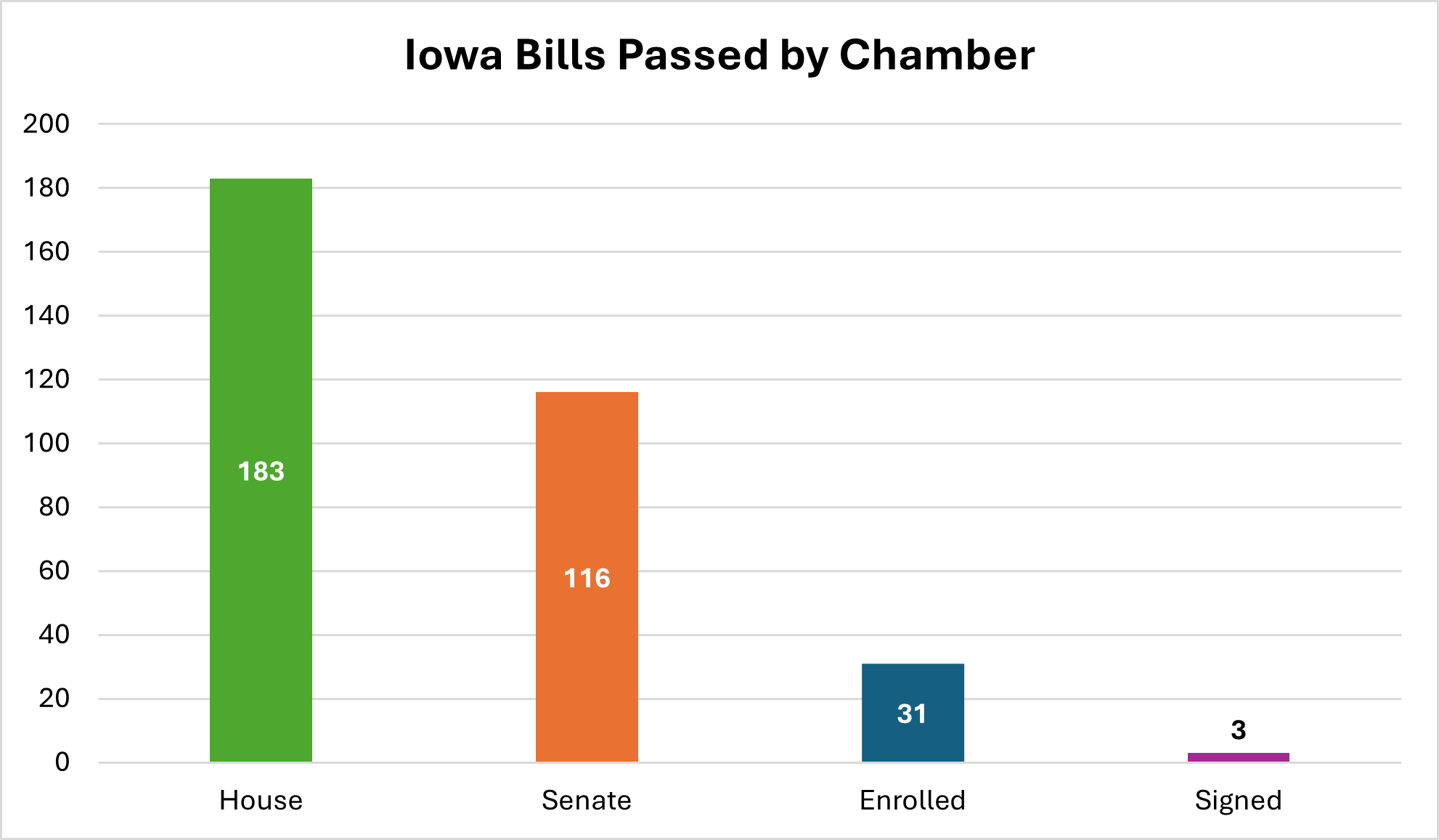
After floor debate and final committee meetings, the chambers held a short week, and many legislators headed back to their districts on Wednesday afternoon.
Health Maintenance Organization (HMO) Taxable Funds
Two weeks ago, the House amended and passed HF 2739, which changes the current tax on HMO premiums, replacing it with a tax on HMO taxable funds. The bill was messaged to the Senate, which sought to debate the bill on the floor on Tuesday afternoon. However, HF 2739 was not placed on the unfinished business calendar. To consider the bill, the chamber had to take a full floor vote to place the legislation on the unfinished business calendar, which is not typical of high-priority legislation.
Ultimately, the bill passed the Senate floor by a narrow margin of 26-19, and Governor Reynolds signed the bill on Thursday as the third bill signed into law so far this session.
As passed, HF 2739 temporarily increases the tax rate on health maintenance organizations to 3.5% from January 2026 through the end of September 2026, before the rate drops to 0.95%. Additionally, the bill authorizes a one-time transfer of approximately $350 million from the Taxpayer Relief Fund to the General Fund and to increase the supplemental appropriation to $89 million to HHS for Medicaid.
As the legislative focus shifts to the state’s budget, this bill provides additional funding to address the budget shortfall, specifically the Medicaid shortfall. In their March meeting, the Medicaid Forecasting Group, which regularly projects Iowa’s Medicaid expenses, projected a $90.6 million deficit in FY26 and a deficit of $167.6 million in FY27.
2026 Election Challenges
The filing period of the 2026 primary elections opened Monday, February 23, for state and federal offices and closed Friday, March 13. The final day to file written objections to nomination petitions for state and federal offices was Friday, March 20. Individuals may be removed from the June 2 primary ballot if their petitions do not hold up to the objections.
The objections are heard by a panel consisting of the Secretary of State, Attorney General, and Auditor of State. However, State Auditor Rob Sand, who is running for governor of Iowa, abstained from consideration of the objections to Rep. Eddie Andrews and Jardon Gadson’s petitions and was replaced by Secretary of Agriculture Mike Naig for those considerations.
Rep. Andrews’ petitions to be placed on the ballot for Governor were reviewed over the course of two days, and ultimately, Rep. Andrews met the petition signature requirements in 19 counties, which is the exact amount required under Iowa law.
| Candidate | Objection(s) | Result |
| Eddie Andrews (Republican Candidate for Governor) | Signature Requirement Nomination Paper Size Nomination Paper Header Information | Objection Denied; On Ballot |
| Jardon Gadson (Democratic Candidate for Iowa House District 75) | Signature Requirement Affidavit of Candidacy | Objection Upheld; Off Ballot |
| Xavier Carrigan (Democratic Candidate for U.S. House of Representatives Iowa District 3) | Signature Requirement | Objection Upheld; Off Ballot |
| Mike Bousselot (Republican Candidate for Iowa State Senate District 23) | Notarization of Affidavit of Candidacy Signature Requirement Residency Requirement | Objection Denied; On Ballot |
| Eric Pearson (Republican Candidate for Iowa State Senate District 21) | Signature Requirement | Objection Upheld; Off Ballot |
This is the complete list of primary candidates.
What’s next?
Beginning in Week 12, the only bills eligible for consideration are:
- Bills passed by both Houses
- Appropriations Bills
- Ways and Means Bills
- Government Oversight Bills
- Legalizing Acts
- Administrative Rules Review Committee Bills
- Committee Bills related to delayed or suspended Administrative Rules [Iowa Code Sec. 17A.8(9)]
- Bills co-sponsored by Majority and Minority Leaders of one House
- Conference Committee Reports
- Companion Bills sponsored by Senate and House Majority Leaders
- Concurrent or Simple Resolutions
- Joint Resolutions nullifying Administrative Rules
- Bills on the Veto Calendar (Joint Rule 23)
- Unfinished Business
With the second funnel now behind us and the release of the March REC estimates, both chambers are expected to establish budget targets in the coming days. This will prompt Appropriations Chairs to begin developing the budget in earnest. From there, the House, Senate, and Governor’s Office will work to align final budget agreements, which must be approved by both chambers before being sent to the Governor for consideration.
Leadership will continue negotiations on high-priority issues, including property tax, the state budget, health care, and eminent domain. As these discussions largely occur behind the scenes, legislators may see shorter floor weeks in the near term. This dynamic typically signals the legislature’s transition toward final negotiations and eventual adjournment ahead of the 100th scheduled day of session.