April 21, the scheduled 100th day of session, is just one day away, and legislators are working on several outstanding issues. Week 14 featured subcommittee and committee meetings on state budget bills, a new property tax amendment, and floor debate.
Alongside budgets, several high-profile bills are moving through the legislative process.
- SF 2490 relates to oil and gas production amid discussions for starting extraction of geological hydrogen in Iowa. The bill caught the attention of eminent domain advocates, who expressed concerns about landowner mineral rights and the 25% pooling standard laid out in the bill. SF 2490 places a 6% severance tax on the oil and gas extracted—70.1% to the Taxpayer Relief Fund, 9.9% to each county in proportion to population, 5% to the counties of extraction, 5% to the Road Use Tax Fund, and 10% to the Environment First Fund. As companies seek to extract geological hydrogen in Iowa, the bill seeks to update and modernize the current system and to facilitate development in the state.
- Passed the Senate 32-15
- SF 2417 establishes requirements and guidelines for conversational AI services. The bill sets out requirements for chatbot interactions with minors, requires a regular consumer disclosure, and directs operators to establish suicide and self-harm protocol to protect users’ mental health. SF 2417 creates penalties and enforcement standards for the violation of this bill, which takes effect in July ’27.
- Passed the House and Senate unanimously and signed by Governor
- SF 2480 regulates and taxes alternative nicotine and vapor products. The bill would impose a five-cent tax on distributors (proportional to container size or liquid amount) and deposit the revenues into the Health Care Trust Fund, directing $3 million annually to the University of Iowa Children’s Hospital for pediatric cancer and related matters.
- Referred to and passed Senate Ways and Means Committee
- HF 2757 creates sales and uses tax exemptions and refunds for purchases related to commencing or restarting operations at a nuclear electric generation facility. The bill was amended on the floor to include a sunset clause and set standards for repayment if a company fails to become operational. This bill would specifically impact the Duane Arnold Energy Center in Palo, and the legislation aims to make the state more competitive for nuclear energy companies.
- Passed House 94-1
- SF 2498 also creates sales and uses tax exemptions and refunds for nuclear generation facilities. The bill makes these exemptions contingent upon making a 5% contribution to the state board of regents for establishing and maintaining a nuclear energy program.
- Passed Senate Ways and Means Committee and referred to the Senate Appropriations Committee
House Property Tax Amendment
As one of the defining issues of the 2026 legislative session, property taxes were once again part of the conversation in Week 14. Two weeks ago, the Senate passed SF 2472, its property tax bill, over to the House. The House referred SF 2472 to the House Ways and Means Committee where it will need to receive a subcommittee and committee vote to continue to be considered. The House has its own property tax proposal which has not yet received a chamber vote (HF 2745).
Last Thursday, the House Ways and Means Chair Carter Nordman filed a “strike-after” amendment to the property tax legislation. H-8374, if adopted, would keep the main portions of HF 2745 (such as a 2% growth cap on all property tax levies) but would make some changes including:
- Lowering the school foundation levy by $.50
- Changes to the urban renewal section to allow schools to opt into including the foundation levy and changing the implementation date to January 1, 2027, of that provision
- A $15,000 homestead exemption
- Other changes
Notably the House bill and the amendment both do not contain key provisions of the Senate bill, such as:
- An increase in the gas tax
- An option to increase the local option sales tax
- The re-creation of a multi-residential property tax classification
- Changes to how the rollback calculation works
Both chambers will continue to work together to achieve this top policy priority before adjourning.
2026 Budget Update
The legislature must approve the state budget for the upcoming fiscal year. Both the House and Senate have introduced their budget bills, which are split by subject. All Senate budget bills have passed through the Appropriations Committee and could be voted on by the Senate at any time but are typically held while the chambers negotiate. The House has yet to introduce a budget bill related to the Rebuild Iowa Infrastructure Fund, but all other budget topics have bills that have either passed through committee or have subcommittees assigned.
With the end of session in sight, movement on these bills signals that the chambers are positioning budget legislation to be voted on as soon as an agreement is reached. However, the billion-dollar state budget shortfall last fiscal year and decreased revenue projections add increased pressure to these negotiations, and pending tax legislation raises questions about the amount of money available for these appropriations.
The table below displays the topic area, budget bills related to the topic, and the last bill action taken by the originating chamber.
2026 Conference Committees
While a relatively uncommon practice in recent general assemblies, two bills entered conference committee last week. Bills are sent to conference committee when the House and the Senate cannot agree on the final bill language and have rejected the language proposed by the other chamber through a floor vote. Five members from each chamber are appointed by leadership – three from the majority party and two from the minority – to discuss the points of disagreement and attempt to reach an agreement. If a compromise is reached, a conference committee report amends the bill to reflect the changes agreed upon by both chambers. The chamber of origin considers the conference committee first and cannot amend it. In the past, chamber leadership has played a large role in what the final bill looks like, even if they are not officially on the conference committee.
SF 2218 requires the Iowa Board of Education Examiners, school districts, accredited nonpublic schools, and charter schools to require license applicants to verify their legal status to live and work in Iowa. This bill is in response to the arrest of former Des Moines Public Schools superintendent Ian Roberts and his order of removal by the U.S. Department of Homeland Security. The House amendment requires the use of the E-Verify/SAVE system and expands the scope of the bill to include the provision of a false social security number to an employer, prospective employer, or potential employees as well as outlining qualifications for state employment, professional licensure, voter registration, and bail. The Senate refused to concur with the House amendment, the House insisted, and a conference committee was appointed.
HF 2200 relates to prohibited activities in the administration of alcoholic beverage control by the Department of Revenue. The House refused to concur with the Senate amendment that adds a section about ownership interest exceptions for authorized noninstitutional investors. The Senate insisted on the amendment, and chamber leadership appointed a conference committee to convene on the bill.
Governor Reynolds Signs Bills into Law
On April 16, Governor Reynolds issued a press release announcing the signing of legislation passed by the 91st General Assembly in 2026. Bills receiving a signature include:
- SF 2463: A bill for an act concerning the executive branch rulemaking process, including the uniform rules on agency procedure and review and regulatory readoption of rules, and including effective date provisions.
- SF 2411: A bill for an act establishing an Iowa-Ireland trade commission.
- HF 863: A bill for an act relating to the use of blue lights on vessels operating on water under the jurisdiction of the natural resource commission.
- HF 2202: A bill for an act relating to controlled substances schedules and precursor substances reporting requirements, making penalties applicable, and including effective date provisions.
- HF 2227: A bill for an act relating to land restoration following the initial construction of electric transmission lines and including effective date and retroactive applicability provisions.
- HF 2253: A bill for an act relating to terminology involving a pregnant female.
- HF 2296: A bill for an act restricting counties and cities from issuing a local form of identification.
- HF 2303: A bill for an act relating to regulation of professional and amateur kickboxing by the state commissioner of athletics.
- HF 2337: A bill for an act relating to fraudulent practices involving academic credentials or professional or occupational licenses and making penalties applicable.
- HF 2345: A bill for an act relating to matters under the purview of the Iowa Public Employees’ Retirement System and the Municipal Fire and Police Retirement System and including effective date provision.
- HF 2357: A bill for an act relating to statutory corrections that adjust language to reflect current practices, correct grammar, insert earlier omissions, delete redundancies and inaccuracies, resolve inconsistencies and conflicts, remove ambiguities, and establish code editor directives.
- HF 2434: A bill for an act relating to insurance coverage for health care services provided pursuant to a referral by an out-of-network primary care provider.
- HF 2500: A bill for an act relating to contracts entered into by state agencies and including applicability provisions.
- HF 2522: A bill for an act relating to the required beneficiary and use of a public officer insurance policy and including effective date provisions.
- HF 2534: A bill for an act relating to animal feeding operations by regulating shellfish and making penalties applicable.
- HF 2583: A bill for an act relating to emergency planning and coordination for electric transmission line owners and providing penalties.
- HF 2619: A bill for an act creating the uniform family law arbitration act.
- HF 2643: A bill for an act relating to reporting total gasoline and diesel fuel gallonage sold and dispensed by retail dealers for a determination period.
- HF 2660: A bill for an act relating to decedent property, including deposit accounts, small estate affidavits, and distribution of child support.
- HF 2680: A bill for an act relating to certified medication aides.
- HF 2697: A bill for an act relating to the payment of pecuniary damages, restitution, and prosecution costs.
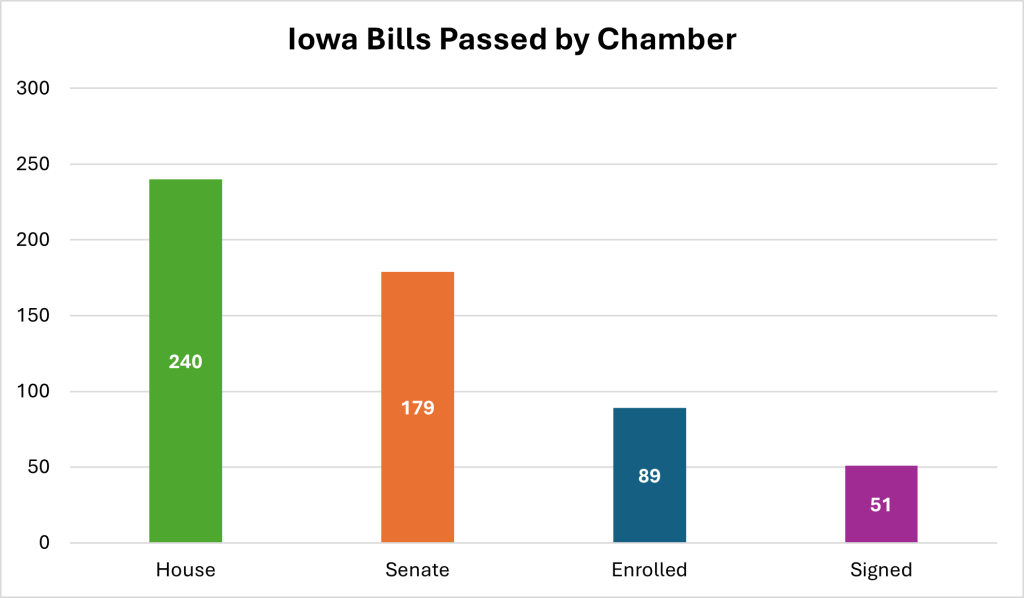
The signing of these bills brings the total number of bills signed to 51 in 2026.
Q1 Federal Fundraising Numbers
With the June primary rapidly approaching, Q1 fundraising data and campaign finance reports provide key insight to competitive races, and which candidates are gaining ground. Strong fundraising demonstrates support for a candidate, builds name recognition, and allows access to expensive media markets.
These are the available numbers for the first-quarter reporting of races in Iowa.
2026 Iowa Retirement Tracker
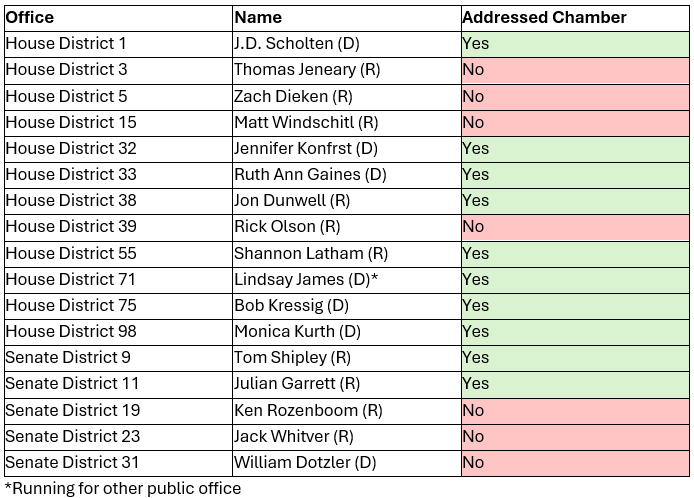
State legislators retiring from office address the chambers in retirement speeches as session moves to a close. With the 100th scheduled day of session upon us, both the House and the Senate yielded the floor to retiring legislators.
Soil Temperature Update
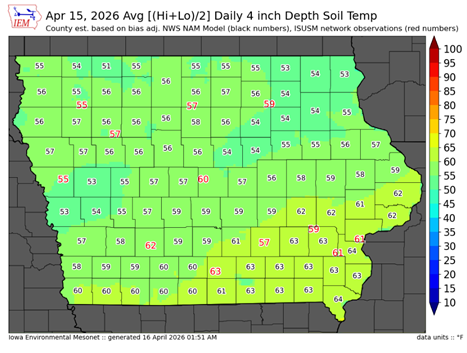
Historically, Iowa’s legislative calendar is based around the planting and growing season, and the legislature typically adjourns around the time when the soil temperature is high enough to begin fieldwork for the new growing season. According to Iowa State University Soil Monitoring, current soil temperatures are solidly in the 50s and 60s across the state.
What’s next?
This week marks the 100th scheduled day of session on April 21 when the legislative per diem ends. However, the legislature has yet to reach an agreement on property taxes and state budget bills, and renewed conversations surrounding eminent domain will extend session beyond 100 days.