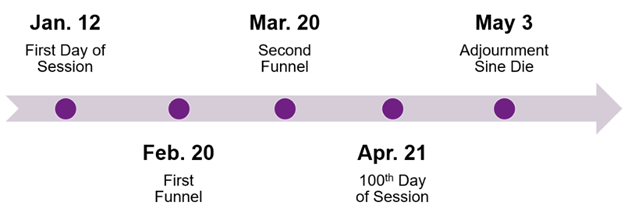
The Iowa legislature adjourned sine die on May 3, 2026, after marathon caucuses and floor debate through the night on Saturday, May 2, and most of the day on Sunday, May 3. Slated for 100 days, the legislature extended 12 days beyond April 21 when their per diem expenses ended, after reaching an agreement on a $9.6 billion state budget for fiscal year (FY) 2027 and much back-and-forth on property tax legislation.
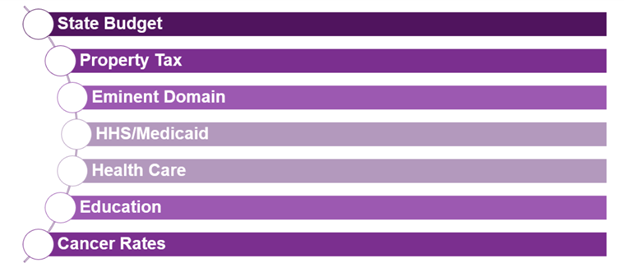
Major policy issues the legislature was anticipated to tackle included property tax reform, eminent domain, rising cancer rates, and the state budget shortfall. Legislation addressing each of these policy areas was introduced and moved through the legislative process to varying degrees.
The second year of the 91st General Assembly featured another record-breaking number of bill introductions after 2025’s record-breaking year. Governor Reynolds has three days (excluding Sundays) to sign or veto bills received during the legislative session. If the bill is passed within the final three days of the legislative session, the Governor has 30 days to sign or veto the legislation. It is typical for the legislature to hold bills during session until requested by the Governor so that she has the full 30 days to consider the legislation. Signed bills become law on July 1, unless otherwise specified.
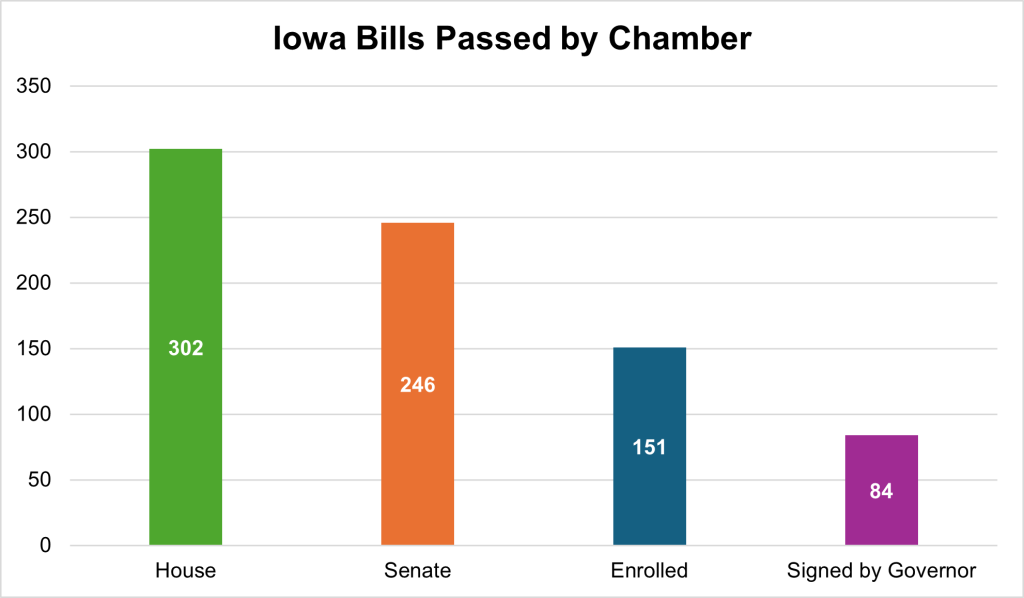
Chart updated according to the Iowa Legislative website as of sine die.
Property Taxation
As the top issue heading into the 2026 Iowa Legislative Session, legislators were eager to tackle property taxation. During the first week of session, the Governor and the Senate introduced versions of a property tax plan, and the House followed shortly thereafter. Highlights of the original bills include:
Subcommittees and public hearings were held on the original versions of the bills. At these meetings, legislators reiterated that the bills were not final, but they served as a starting point for a property tax system overhaul. After these public meetings, the House and Senate each amended their bills in their Ways and Means committees, renumbering the bills to HF 2745 and SF 2472, respectively. Each chamber continued to work on its bills throughout the session. In early April, the Senate acted first and passed its proposal, after amendment, with a bipartisan 41- 4 vote.
After the Senate sent its bill to the House, the House held a subcommittee and public hearing before releasing an amendment to the bill. The public hearing focused on provisions within the Senate bill that would increase gas taxes and rental property taxes. The House amendment was functionally identical to the latest amendment released on their bill and removed many of the provisions in the Senate proposal like the senior homestead enhancement, adjusting the budget limitation for inflation, the gas tax increase, and the rental property tax changes. On April 22, the House adopted its amendment on the Senate bill and passed SF 2472 back to the Senate (64-23).
After marathon negotiations lasting through the weekend, the chambers agreed on a final 83-page property tax bill. SF 2472 was one of the final policy bills passed by the legislature and one of the largest property tax bills in Iowa’s history.
Key provisions of the final bill include:
- A 102% cap on most local governments’ property tax collection growth
- Re-establishes the multiresidential property tax category with a lower benefit from the rollback system
- Lowers the school foundation property tax by 50 cents
- Re-creates the homestead credit as a tax exemption worth 10% of a home’s value
- Ends future perpetual urban renewal zones and limits existing zones
- And over a dozen more provisions
Notably, the final bill did not include other major items discussed throughout session, such as the removal of the rollback, an increase to the gas tax, or an option to increase the local option sales tax. SF 2472 is on the Governor’s desk as the defining bill of the session.
Health Maintenance Organization (HMO) Tax
HF 2739 changed the current tax on HMO premiums, replacing it with a tax on HMO taxable funds. The bill temporarily increases the tax rate on health maintenance organizations to 3.5% from January 2026 through the end of September 2026, before the rate drops to 0.95%. Additionally, the bill authorizes a one-time transfer of approximately $350 million from the Taxpayer Relief Fund to the General Fund and to increase the supplemental appropriation to $89 million to HHS for Medicaid. HF 2739 provides additional funding to address the budget shortfall, specifically the Medicaid shortfall.
Republicans stated that this increase was needed to take advantage of changes in federal law capping future HMO taxes and to cover the Medicaid shortfall, while Democratic members of the legislature predicted that these tax increases would be passed onto Iowans, raising healthcare premiums. HF 2739 was one of the first bills signed by the Governor in 2026.
Iowa Make America Healthy Again Act
HF 2676, the “Iowa Make America Healthy Again Act” (MAHA), implements wide-ranging education, health, and nutrition reform. This bill was one of the Governor’s top priorities in 2026, and upon its passage, she stated:
“I’m grateful to the House and Senate for passing Iowa’s MAHA bill which takes common sense steps to improve health and well-being for Iowans of all ages…. Food assistance programs will now emphasize nutrition. School lunches will eliminate certain unhealthy dyes and additives. Doctors will benefit from evidence-based nutrition courses and, in turn, support better patient education, engagement, and healthier outcomes. And we’ll increase access to behavioral health care by allowing psychologists licensed in other states to practice in Iowa.”
Specific provisions include:
- Requiring the Board of Medicine to adopt rules to require certain practitioners to complete continuing education on nutrition and metabolic health.
- Requiring Iowa medical schools to require students to complete at least 40 hours of coursework on nutrition and metabolic health.
- Directing the Department of Health and Human Services to implement a SNAP waiver program.
- Providing authority to the Director or Director’s designee to define healthy foods.
- Implementing public school meal standards for districts providing food and beverages to students.
- Requiring nonpublic schools receiving state funding for meals to fulfill the same requirements.
- Making over-the-counter ivermectin available.
- Outlining student instructional technology standards, limiting digital instruction to 60 minutes per school day for K-5 and requiring school districts to adopt a written K-5 technology use policy.
- Convening a working group for the impact of technology on cognitive learning.
- Requiring K-4 students to engage in 40 minutes of physical activity and 5th grade students to engage in at least 30 minutes of physical activity per day.
- Including the Presidential Physical Fitness Test in physical education curriculum
- Establishing a Psychology Interjurisdictional Compact
Nicotine and Vapor Product Taxation
SF 2480 regulates and taxes alternative nicotine and vapor products. The bill imposes a five-cent tax on nicotine products like pouches and vapor products, and the first $3 million of revenue each year goes to the University of Iowa Children’s Hospital for pediatric cancer research, with additional funds being used to fund Medicaid. Funding pediatric cancer research has been a top priority of many Iowa legislators, including Majority Leader Klimesh, and SF 2480 provides a recurring revenue source for the research. Should SF 2480 be signed into law, it will be Iowa’s first nicotine-specific excise tax.
Governor Reynolds’ Legislative Priorities
Going into her final year in office, Governor Kim Reynolds laid out her agenda in her Condition of the State Address. The speech covered a wide range of policy priorities, including property taxes, high cancer rates, the health of Iowans, and controlling government spending. The Governor reinforced Iowa’s strong condition as a state and released her vision for Iowa and state budget recommendations. The Governor outlined her top priorities as:
- Delivering property tax relief
- Creating a healthier Iowa
- Expanding educational freedom
- Keeping Iowa’s farms in the family
- Serving Iowans who served us
- Preserving public safety
Following adjournment, Governor Reynolds released a statement applauding the work done by the legislature to advance these priorities, stating:
“As I reflect on the end of my final legislative session, I’m incredibly proud of the work we’ve accomplished together on behalf of Iowans this year. With only a modest 1.4% increase to the state budget, Republicans are delivering big for Iowans… Throughout my time in office, the commonsense, conservative policies we’ve enacted will ensure our state remains strong, prosperous, and vibrant for generations to come. That has been my commitment to Iowans since day one, and I will continue to serve with that same purpose during my final months in office.”
What’s next?
Dentons Davis Brown Government Relations clients will receive a comprehensive review of all legislation of interest from this legislative session once the Governor’s 30-day veto period is over.
Now that the legislature has adjourned, elected officials will turn their attention to interim activities ahead of the 2026 midterm elections. For several incumbents, this involves campaigning in primary and general elections. The primary election is June 2, and with early voting starting soon, many legislators have transitioned directly into the home stretch of their primary campaigns. Beyond campaign work, legislators will continue in-district activities and start laying the groundwork for the next General Assembly.